
When the Future Asks Who You Were
The Question That Won’t Go Away
There’s a moment that’s coming. It hasn’t happened yet, but it will.
Years from now, a younger relative, a grown kid, a grandchild, or maybe even someone who once worked for you will ask about this stretch of time. What was it like back then? What did you believe? What did you stand for? And then the harder question. What did you do about it?
That question isn’t about how we felt. It’s about what we did with the voice we were given. Because silence is not neutral. Silence is a position. Silence is complicit. History doesn’t record our internal wrestling or monologue. It records what we stood up for and spoke out against when it mattered.
Finding Your Voice Before You Raise It
Most of us don’t lose our voice all at once. We slowly talk ourselves out of using it.
We tell ourselves to wait. To gather more information. To not overreact. To keep the peace. To stay in our lane. To not make people uncomfortable. And before we know it, the moment passes and silence has done its work. Our message has been sent.
But there’s other signals we’re given long before certainty shows up. Our gut. Our heart. That internal knowing that something isn’t right, even if we can’t yet explain it perfectly.
Those signals matter.
Following your heart and gut isn’t recklessness or being “too emotional”. It’s the wisdom and drive that comes from lived experience. Learned from years of paying attention. From knowing the difference between inconvenience and injustice.
What Amanda Gorman Is Really Saying
That’s the space Amanda Gorman speaks into with her poem written in the wake of Alex Jeffrey Pretti’s death. She isn’t only grieving a life lost. She is putting words to what happens when people are asked to ignore their conscience in the name of order.
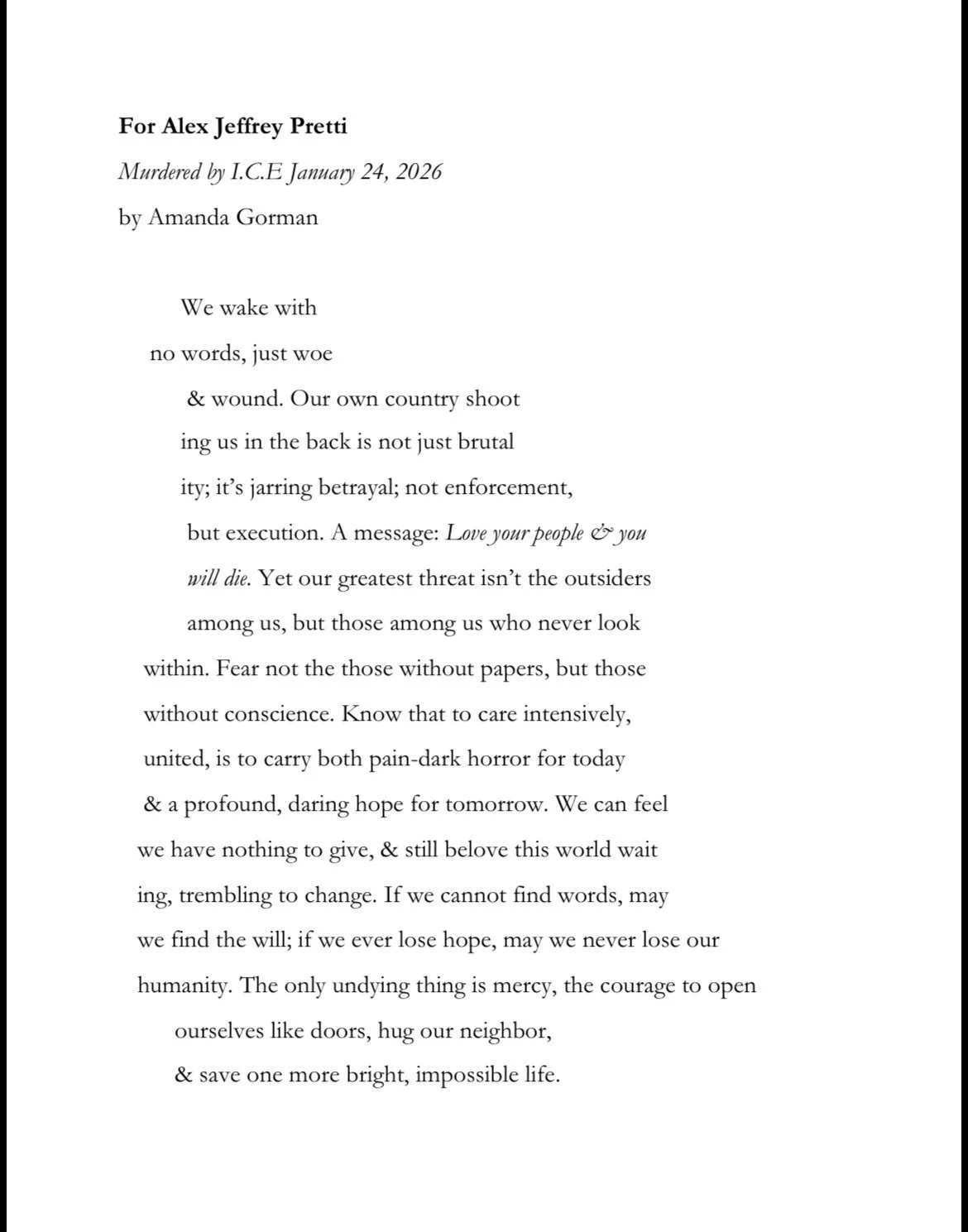
The poem draws a clear line between authority and humanity. Between enforcement and execution. Between following commands and protecting life. And then it turns outward, toward all of us.
When she writes, ‘‘Fear not those without papers but those without conscience”, she’s telling the truth plainly. The danger is not disagreement. The danger is blind obedience without love. Demanded compliance without discernment. Power enforced to protect the strong with no consideration to stand in favor of the weak. Her poem isn’t asking abut how we feel. It’s asking whether we will listen to that inner voice that tells us something is wrong, and whether we’ll act on it.
Trust What You Saw. Trust What You’ve Lived.
Most of us recognize that moment. The one when what we’re told doesn’t match what we’ve witnessed. When the explanation feels thin, even false. When your body registers dissonance before your brain starts negotiating it away.
That isn’t emotion. That’s wisdom.
Your years matter. Your experiences matter. They shape your moral clarity and compass. Then one day, when someone younger will ask what you did with that clarity. “I didn’t want to cause trouble” won’t sound like wisdom then. “I didn’t want to make anyone uncomfortable” won’t sound like good manners.
When Speaking Up Takes Different Forms
Using your voice doesn’t look the same for everyone.
For some, it’s speaking up in a room where silence is expected. Speaking up in a room for someone who it not there to defend themselves.
For others, it’s writing, calling, or showing up.
Sometimes it’s marching and carrying protest signs. Sometimes it’s walking quietly with others so they know and feel they are not alone.
Sometimes it’s donating, organizing, or protecting someone who is being targeted.
There is no single right form. The point is action.
Follow what is motivating you toward truth, reality, and being a good human. Let your heart and gut guide how you show up. Protest if that’s what’s stirring in you. Walk if that’s how you process. Speak if that’s where your courage is growing. Remember, courage is not the absence of fear, it’s taking that action, speaking those words, showing up at that rally even though you are afraid.
What matters is that you don’t stay still. Don’t stay silent.
People Are Paying Attention
Your kids are watching this closely. So are your neighbors, your friends and your community. Not your posts, but your presence.
They’re learning whether your compassion is performative. Whether dignity is defended or negotiated. Whether love of neighbor is something we talk about or something we practice.
They won’t ask if you were comfortable or even safe. They will ask, did you stand up for people when it mattered? Did you give a voice to those that desperately need it?
When Leadership Is Tested
If you lead people, employ people, or influence people, then you must realize this moment is not abstract.
Leadership shows up in who you protect, what you tolerate, and whether truth is allowed to prevail or quietly buried to preserve order and comfort. Neutrality does not preserve peace. It preserves power. Regardless of who possesses it.
Standing up for dignity is not political. It is moral. It is human.
The Story We Hope to Tell Later
One day the question will come.
Our hope should not be that we feel good about ourselves. Our hope should be that we can confidently say we listened to our conscience. That we followed our heart and gut toward truth. That we used our voice and privilege in ways that protected dignity and affirmed humanity. That we loved our neighbor in real, tangible ways, even when it cost us comfort, approval, or certainty.
This is not about being loud for the sake of noise. It is about refusing to let fear, lies, or dehumanization have the final word.
Truth matters. People matter.
Love your neighbor.
Just keep running…and I know we are all tired,
Justin and Sarah